Cloud security has traditionally been built around a familiar sequence:
Create → Detect → Alert → Triage → Assign → Fix → Verify
That sequence made sense when infrastructure changed comparatively slowly and security teams had meaningful time between configuration mistakes and attacker exploitation.
Cloud changed the first assumption.
Automation changed it again.
AI is changing it further.
Infrastructure can now be created, altered, scaled, and destroyed continuously through APIs, infrastructure as code, platform automation, CI/CD pipelines, autonomous systems, and increasingly AI-assisted engineering.
The security model needs to move at the same speed.
The question is no longer only:
How quickly can we detect an insecure cloud configuration?
For many classes of risk, the better question is:
Why did the cloud accept the insecure state in the first place?
That is the case for preventive guardrails.
The cloud security problem is becoming a timing problem
Misconfiguration remains one of the most persistent ways attackers gain access to cloud environments.
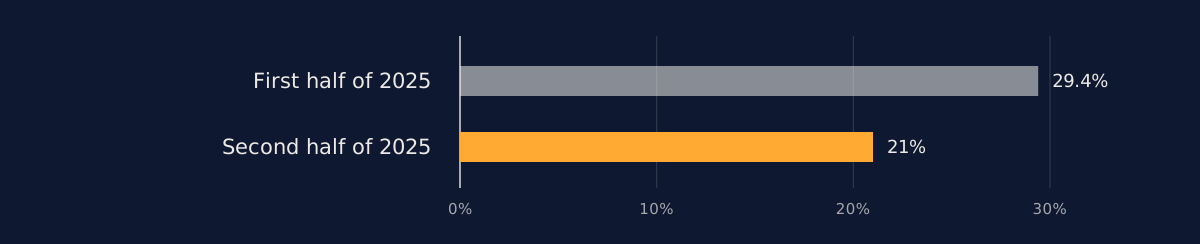
Google Cloud’s H1 2026 Threat Horizons report found that misconfiguration’s share of observed initial-access incidents fell across 2025, and specifically noted that the decline appeared consistent with automated guardrails making identity and configuration mistakes harder to exploit.
That is significant.
It suggests that cloud security is not limited to becoming better at discovering mistakes. There is evidence that making unsafe states harder to create can actually force attackers toward more difficult and expensive paths.
At the same time, the window for defenders is shrinking.
Google security engineers observed attackers exploiting misconfigured applications and deploying secondary payloads within an hour of the resource being created.
Unit 42’s 2025 incident-response data found that attackers exfiltrated data within the first hour in about a fifth of cases, and within five hours in a quarter of cases.
Mandiant’s 2026 M-Trends research illustrates the broader acceleration even more starkly: the median time between opportunistic initial access by one criminal group and handoff to a secondary group fell from more than eight hours in 2022 to 22 seconds in 2025.
Those datasets measure different things. They should not be collapsed into a single statistic.
But they point in the same direction:
The amount of time between an unsafe condition appearing and someone being able to use it is getting shorter.
A cloud control that discovers a dangerous condition tomorrow may therefore be technically effective and operationally too late.
Detection creates an exposure window
Consider a simple example.
An engineer changes a security group to expose an administrative service to the internet.
A CSPM platform detects it five minutes later.
The alert is enriched ten minutes after that.
A ticket is created.
The application owner sees the ticket three hours later.
The team evaluates the impact the following morning.
The configuration is changed that afternoon.
From an operational perspective, the security system worked.
It discovered the problem.
It routed the problem.
The team fixed the problem.
But from an attacker’s perspective, the important metric is different:
How long was the unsafe state real?
This leads to a more useful way of thinking about cloud posture.
The exposure-window model
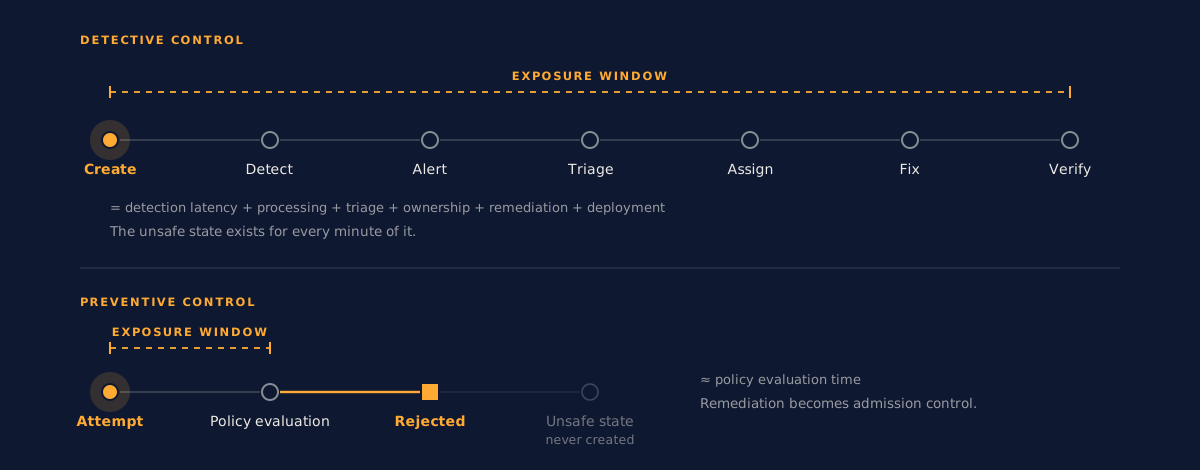
For a detective control:
Exposure Window = Detection Latency + Processing + Triage + Ownership + Remediation + Deployment
Some of those components may take seconds.
Others routinely take hours or days.
And every minute in that sequence is time during which the dangerous configuration may actually exist.
With a preventive control:
Exposure Window ≈ Policy Evaluation Time
The attempted change reaches the cloud boundary.
The policy evaluates it.
The operation is rejected.
The unsafe resource state never materializes.
That does not merely improve mean time to remediation.
It changes the problem from remediation into admission control.
Prevention has very different economics from remediation
Imagine an organization repeatedly finding that storage is publicly accessible.
A detective-only program might generate:
- a finding;
- an alert;
- enrichment;
- a ticket;
- engineer investigation;
- owner identification;
- remediation;
- verification;
- closure.
Then someone creates another public bucket.
The entire process repeats.
The security team becomes very efficient at processing the consequences of the same policy violation.
But the organization has not actually eliminated the class of failure.
A preventive control changes the economics.
If the organizational requirement is:
Production storage containing protected data may not be publicly accessible.
and the organization can express that policy safely at the cloud control plane, then every future violation can potentially be rejected at creation time.
One policy decision replaces an indefinite number of future tickets.
This is where cloud security starts to compound.
Detection scales approximately with the number of violations.
Prevention can scale with the number of rules governing violations.
That distinction becomes more important as infrastructure velocity rises.
The cloud providers themselves are moving toward this model
Preventive cloud governance is not an abstraction invented by security vendors.
The major cloud providers expose native enforcement mechanisms specifically because detection alone is insufficient.
AWS
AWS Control Tower explicitly distinguishes three types of controls:
- Preventive controls
- Disallow actions that would violate policy.
- Detective controls
- Identify resources that have become noncompliant.
- Proactive controls
- Evaluate resources before CloudFormation provisions them and can reject resources that fail the control.
AWS implements preventive controls through mechanisms including Service Control Policies and Resource Control Policies. SCPs establish the maximum permissions available to identities within member accounts, creating an organization-level boundary that even account-level administrators cannot simply override through ordinary IAM grants.
Microsoft Azure
Azure Policy’s deny effect operates directly in the resource-request path. When a matching resource creation or update violates the policy, Azure can reject the request before it reaches the resource provider, returning a denied deployment rather than creating the noncompliant resource and finding it later.
Google Cloud
Google Cloud Organization Policy provides centrally inherited constraints across organizations, folders, projects, and supported resources. Services enforce those constraints against resource operations, and Google recommends previewing and dry-running policies before broad enforcement.
The architectural pattern is consistent across all three clouds:
Policy should sometimes sit in the path of the change itself.
Detection is still essential
The argument for prevention is not an argument against CSPM, detection, or continuous monitoring.
There are important things preventive controls cannot reliably answer.
For example:
- Is an allowed resource now exposed through a new attack path?
- Did a legitimate permission become dangerous because another relationship changed?
- Is a formerly private workload now reachable through an intermediary?
- Has an identity accumulated unexpected privilege?
- Did application behavior create a security condition that infrastructure policy cannot see?
- Was something created through a path the preventive control does not cover?
- Has runtime drift made a compliant deployment dangerous?
- Is the control itself configured incorrectly?
- Did a new threat make yesterday’s acceptable configuration unacceptable today?
Prevention is strongest for stable, high-confidence invariants.
Detection remains necessary for contextual, evolving, and emergent risk.
The strongest cloud posture architecture is therefore not:
Prevent instead of detect.
It is:
Prevent what should never happen. Detect what cannot safely be prevented. Remediate what remains.
What belongs in a preventive guardrail?
Not every security finding should become a hard deny.
That would make the cloud unusable.
A useful preventive guardrail generally has four properties.
1. The undesirable state is unambiguous
Some states are almost never legitimate.
Examples might include:
- disabling mandatory audit logging;
- creating root access keys;
- turning off required encryption;
- allowing unrestricted access to highly sensitive administrative services;
- disabling required public-access protections on protected storage;
- creating resources outside approved jurisdictions;
- weakening mandatory TLS policy below the organizational minimum.
These are good candidates for prevention because the security requirement is stable.
2. The decision can be made using information available at enforcement time
A boundary control must make a decision quickly.
If determining whether a change is dangerous requires reconstructing a complex, multi-hop attack graph across hundreds of resources, a simple API deny may not be the correct mechanism.
Context matters.
The deeper the contextual requirement, the more likely the control belongs in proactive analysis, detection, or bounded remediation instead of a universal deny.
3. False positives are expensive enough to matter
A false positive in CSPM creates noise.
A false positive in a preventive control can stop production engineering.
The confidence threshold for blocking therefore needs to be considerably higher than the threshold for generating a finding.
4. An exception model exists
Real environments have edge cases.
A guardrail therefore needs a governed escape path:
- explicit exemption;
- scoped resource;
- named owner;
- justification;
- expiration;
- approval where required;
- compensating controls;
- audit trail.
A permanent undocumented exception is not an exception.
It is the new policy.
Prevention should narrow blast radius, not create another one
Preventive security controls are powerful precisely because they can stop actions.
That also makes them dangerous.
An incorrectly deployed organization-wide deny can interrupt workloads across hundreds of accounts.
AWS explicitly recommends testing SCPs on limited organizational units before applying them broadly. Google similarly recommends preview and dry-run capabilities for organization-policy changes.
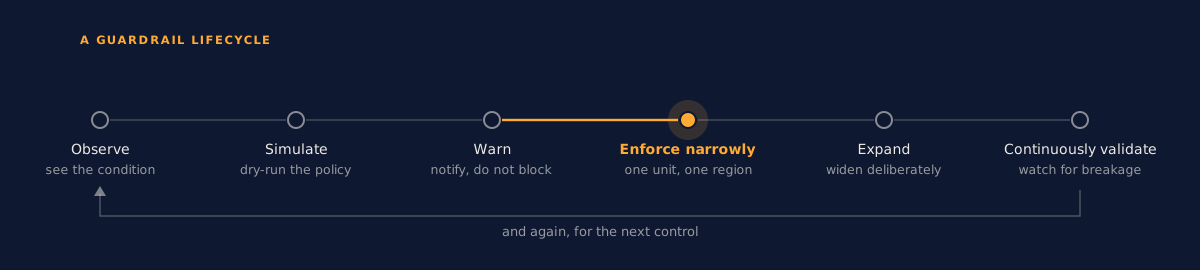
A mature guardrail lifecycle should therefore look something like:
Observe → Simulate → Warn → Enforce narrowly → Expand → Continuously validate
This matters particularly for brownfield environments.
A control that is obviously correct for newly created infrastructure may break a legacy system if applied retroactively without understanding dependencies.
Secure-by-default does not mean:
Turn everything off and hope engineering complains.
It means:
Make the secure path the normal path, understand exceptions, and introduce enforcement deliberately.
Separate preventive controls from remediation controls
These controls solve related but different problems.
A preventive control asks:
Should this requested state be allowed to exist?
A remediation control asks:
This state already exists. What are we permitted to change automatically?
The risk profile is different.
Blocking the creation of an unencrypted storage resource may be straightforward.
Automatically changing encryption configuration on a production datastore that already contains workloads can have operational consequences.
Similarly:
- rejecting a new
0.0.0.0/0administrative rule may be safe; - deleting an existing production security-group rule automatically may disconnect customers;
- preventing creation of a public bucket may be simple;
- changing a currently public bucket to private may break a legitimate distribution workflow;
- preventing deployment of an unapproved region may be safe;
- automatically migrating an existing production workload obviously is not.
This is why remediation must be bounded.
A useful autonomy ladder for cloud remediation
Rather than treating remediation as either manual or fully autonomous, security teams can define levels of authority.
L0ObserveDetect and explain the condition.
No change is made.
L1RecommendGenerate the exact remediation and expected impact.
A human executes it.
L2One-click remediation- The system prepares the action, but an authorized operator explicitly approves execution.
L3Policy-approved automatic remediation- The system can automatically reverse or correct a narrow set of known-safe violations.
L4Preventive enforcement- The dangerous state is rejected before it materializes.
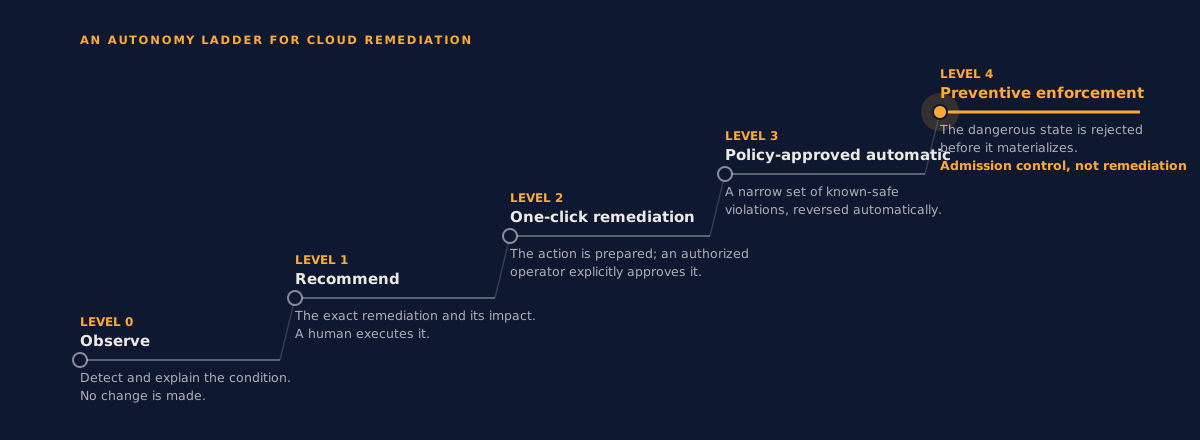
The highest level is not necessarily appropriate for every control.
A mature cloud-security program moves individual controls upward only when confidence, reversibility, and operational understanding justify it.
The most important distinction: reversible versus destructive actions
Automation should reason about operational risk as well as security risk.
A remediation that enables S3 Block Public Access is very different from one that deletes a resource.
A useful decision model considers:
Security impact × Operational impact × Reversibility × Confidence
High-confidence, low-impact, easily reversible changes are strong candidates for automation.
High-impact or irreversible actions should require greater evidence and human authorization.
Examples of comparatively bounded actions may include:
- restoring a previously approved security-group rule;
- re-enabling mandatory logging;
- re-enabling required encryption configuration where the provider supports it safely;
- reverting a known policy change to the last approved state;
- blocking a newly created public exposure before dependencies form.
Potentially destructive operations deserve a much higher bar.
The fact that an AI system can change infrastructure does not mean it should automatically receive permission to do so.
Cloud risk is increasingly about combinations, not isolated findings
There is another reason prevention alone cannot replace contextual posture management.
Individual misconfigurations often become dangerous through combinations.
Tenable’s 2025 cloud research found that more than a quarter of analyzed organizations had at least one workload combining public exposure, a critical vulnerability, and high privilege — what it calls a “toxic cloud trilogy.”
Its 2026 research found that most analyzed organizations operated cloud workloads with known exploited critical vulnerabilities, while identity and external trust remained major contributors to exposure.
Wiz’s 2026 cloud-risk research similarly argues that exploitable risk concentrates where exposure, access, reachability, credentials, and privilege intersect, rather than simply in the raw number of findings.
This suggests a two-part operating model.
At the boundary, enforce stable invariants.
Behind the boundary, continuously reason about relationships.
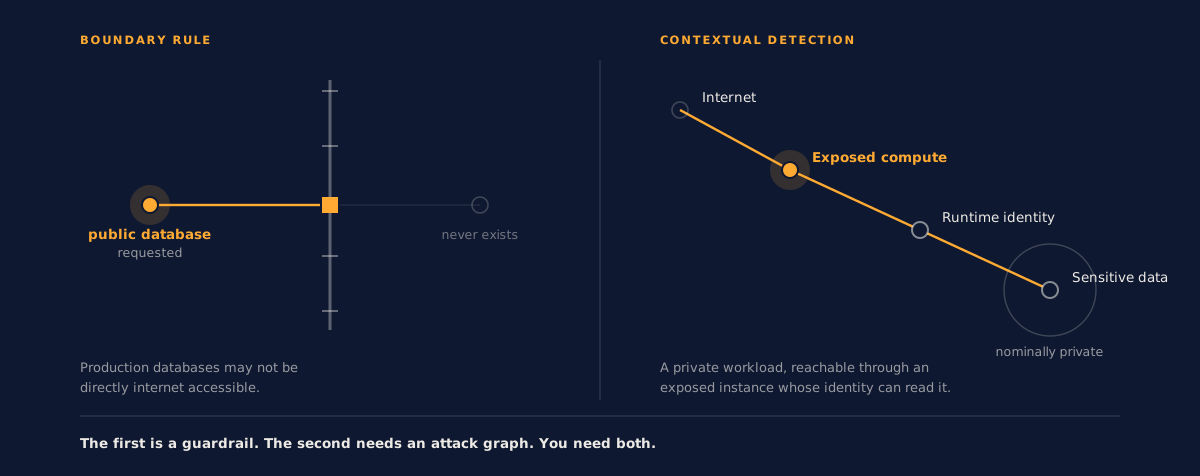
For example:
- Boundary rule
- Production databases may not be directly internet accessible.
- Contextual detection
- This nominally private workload can still be reached from an exposed compute instance whose runtime identity can access sensitive data.
The first is a guardrail.
The second requires an attack graph.
You need both.
Secure defaults are becoming more important as AI increases infrastructure velocity
Cloud configuration mistakes historically came from humans typing commands, copying Terraform, using templates, or misinterpreting provider defaults.
Now infrastructure is increasingly created by machines on behalf of humans.
AI coding systems can generate:
- Terraform;
- CloudFormation;
- Kubernetes manifests;
- IAM policies;
- network rules;
- deployment pipelines;
- serverless infrastructure;
- identity configuration.
That makes the boundary even more important.
The organization should not have to trust every engineer, script, agent, CI pipeline, vendor integration, or future AI model to independently remember every security requirement.
The platform should enforce the important ones.
That is what a security boundary is for.
Microsoft’s July 2026 Secure Future Initiative report offers an instructive example at enormous scale: engineering defaults now keep most pipelines from reaching unapproved package endpoints, and hundreds of thousands of resources have had public access revoked as part of its broader secure-foundations effort. Its conclusion is worth noting: durable security comes from reinforcing defaults and controls, not only from periodically auditing what already exists.
The strategic shift is from:
“Please configure this securely.”
to:
“This platform normally cannot enter the unsafe state.”
An original way to measure whether guardrails are working
Most cloud-security dashboards focus heavily on findings:
- open findings;
- critical findings;
- mean time to remediation;
- compliance percentage;
- aging.
Those are useful.
But a prevention-oriented program should introduce another class of metric:
Prevented insecure-state creation
Measure how often a prohibited state was attempted and stopped.
Examples:
- public exposures prevented;
- prohibited IAM grants rejected;
- encryption downgrades blocked;
- unsafe network changes prevented;
- logging-disable attempts rejected;
- prohibited-region deployments stopped.
Then measure what happened afterward.
Did the developer:
- correct the configuration?
- request an exemption?
- repeatedly attempt the same violation?
- abandon the deployment?
- route around the guardrail through another mechanism?
This creates a much richer security signal.
A blocked operation is not merely an error.
It is evidence about where engineering systems, templates, documentation, AI agents, and platform defaults are still trying to produce unsafe infrastructure.
Guardrails can therefore become an input into platform engineering.
If hundreds of deployments repeatedly collide with the same guardrail, the long-term solution may not be another security ticket.
The solution may be to fix the golden template.
A better cloud posture scorecard
For a prevention-oriented program, we would measure at least:
- percentage of critical policy classes with preventive enforcement;
- prevented policy violations per 1,000 infrastructure changes;
- repeated violation rate;
- exception count and median exception age;
- percentage of exceptions with expiration dates;
- number of resources created insecurely despite applicable guardrails;
- median exposure window for detective-only controls;
- percentage of eligible findings automatically remediated;
- rollback rate for automated remediation;
- human override rate;
- control failure rate;
- guardrail-caused deployment failures;
- security debt recurrence after remediation;
- percentage of infrastructure deployed through governed paths;
- number of material attack paths rather than raw findings.
The goal is not to maximize the number of blocked actions.
A perfect program may actually block fewer operations over time because engineers, templates, agents, and platforms learn to produce compliant infrastructure by default.
That is the compound effect we want.
Where Rapticore ActiveFlux fits
Rapticore ActiveFlux is built around this model.
The objective is not simply to maintain an inventory of cloud findings.
It is to progressively reduce the number of unsafe states an organization has to manage at all.
ActiveFlux uses two complementary mechanisms.
Preventive guardrails
High-confidence security invariants can be enforced close to the cloud boundary so that selected dangerous changes are blocked before they become deployed state.
The important word is selected.
A preventive control should be intentional, explainable, scoped, tested, and auditable.
Bounded remediation
For conditions that already exist, ActiveFlux can apply remediation under explicit policy.
That can range from operator-approved fixes to tightly scoped automatic reversion for known-safe cases.
High-impact resources can require human approval.
Every action should preserve:
- the triggering finding;
- the resource state before the change;
- policy and rule identity;
- decision evidence;
- requested remediation;
- operator approval where required;
- API action taken;
- resulting state;
- rollback information;
- verification result.
The goal is not autonomous cloud administration.
The goal is controlled reduction of exposure.
The future of CSPM is fewer findings
There is a strange incentive hidden in security tooling.
Security products often demonstrate value by showing customers more problems.
More assets.
More vulnerabilities.
More alerts.
More findings.
But the mature outcome of a cloud-security program should be the opposite.
Over time, the system should create fewer recurring findings because entire classes of unsafe state have become difficult or impossible to produce.
A mature lifecycle therefore looks like this:
Discover → Understand → Prioritize → Remediate → Convert recurrence into a guardrail
A recurring high-confidence finding is not only something to fix.
It is a candidate for elimination.
That changes CSPM from a perpetual inspection system into a mechanism for continuously improving the architecture it watches.
Detection tells you that the boundary failed
Detection will always matter.
Attackers change.
Applications change.
Threat intelligence changes.
Relationships change.
No organization can encode every future risk into a static policy.
But where the security requirement is known, stable, and enforceable, discovering the same violation over and over should eventually become unacceptable.
A repeated finding often means one of three things:
- the organization does not actually believe the policy;
- the secure path is too difficult for engineering to follow; or
- the policy is being enforced too late.
The third is a cloud architecture problem.
And architecture can fix it.
The strongest cloud posture programs will still discover risk.
They will still investigate.
They will still remediate.
But increasingly, they will also learn from recurrence and move controls toward the point where risky state is created.
Detect what you cannot prevent.
Remediate what you could not stop.
Learn from what keeps recurring.
Then move the control closer to the boundary.
The best cloud finding is eventually the one that never gets created.